




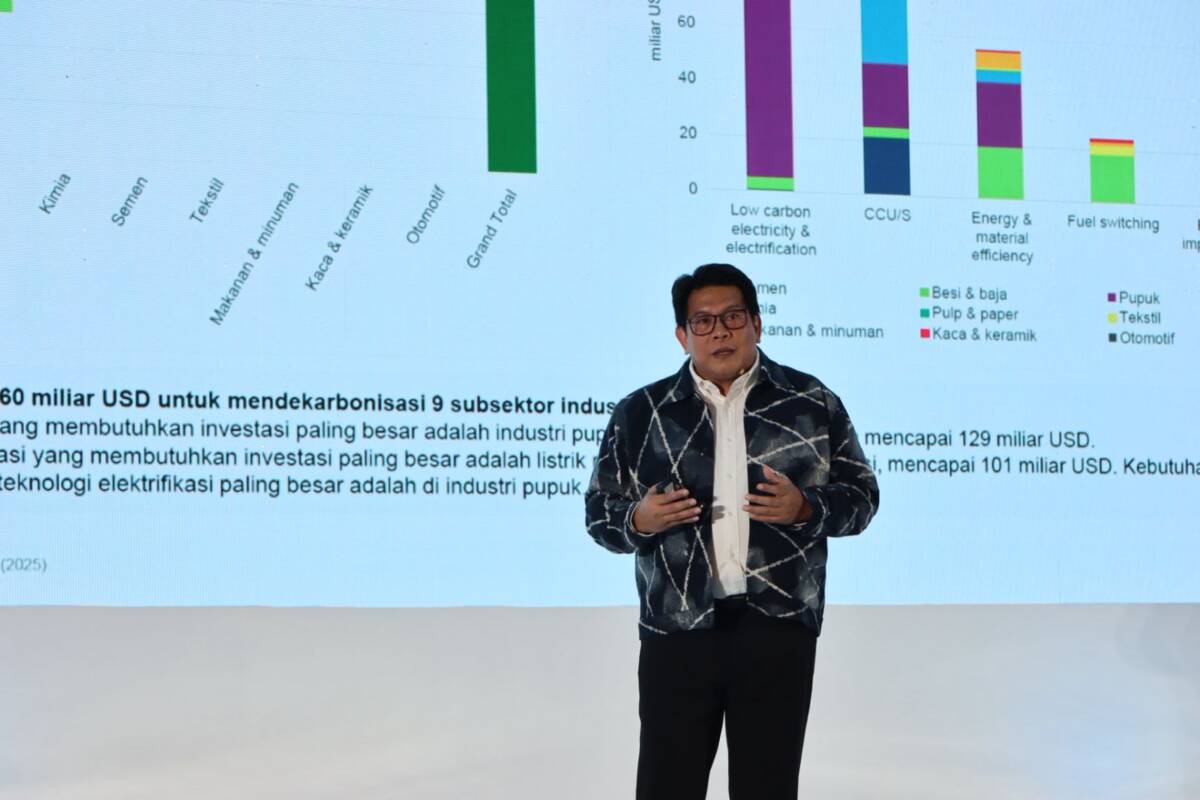
Jakarta, December 2, 2025 – President Prabowo Subianto aims for Indonesia’s economic growth to accelerate to 8 percent in the next few years. Responding to this, Fabby Tumiwa, Chief Executive Officer (CEO) of the Institute for Essential Services Reform (IESR), stated that there is one non-negotiable condition: 8 percent growth will not be achieved without low-carbon intervention in the industrial sector. Fabby made this statement at the SCG ESG Symposium 2025 Indonesia, which featured the theme “Decarbonizing for Our Sustainable Tomorrow” in Jakarta on Tuesday (December 2).
Fabby emphasized that, under a business-as-usual (BAU) scenario, the demand for Indonesian manufactured products ranging from cement, steel, chemicals, to automotive will surge significantly by 2050. IESR data shows that steel production will rise 2.2 times, fertilizer production 2.3 times, methanol production 3 times, and sugar production 2.8 times.
“This jump in demand automatically triggers an increase in industrial emissions. Without decarbonization efforts, industrial emissions will increase by 107 percent, from 154 million tons of CO₂ in 2023 to 319 million tons of CO₂ in 2050. An emission increase of this magnitude not only endangers the environment but also raises industrial energy costs, worsens air quality, and lowers the competitiveness of export products due to increasingly strict global carbon regulations. In other words, without energy transformation, Indonesian industry risks being left far behind its global competitors,” Fabby said.
Fabby further stated that high economic growth is only possible through structural transformation that integrates energy efficiency, renewable energy utilization, industrial process upgrades, and carbon intensity reduction. Without this, Indonesia’s economy will be stuck on a lower-growth BAU path, or even stagnate due to climate pressure, energy costs, and international trade standards.
To this end, Fabby said, Indonesia needs to implement the Decarbonization Roadmap, which outlines five main strategies that industries must immediately adopt. First, replacing coal-based electricity with renewable energy such as solar and wind. The fertilizer, steel, and chemical industries even require massive-scale electrification. Second, switching from diesel to biofuel, or from gas to hydrogen. Third, conserving energy and raw material use through better process technology. Fourth, production process renewal. For instance, replacing the blast furnace (BF-BOF) technology for steel with the lower-emission DRI-EAF. Fifth, using carbon capture and storage technology for sectors whose emissions cannot be directly reduced.
“To implement these strategies, the industry requires a total investment of USD 260 billion until 2050, with the largest needs coming from the fertilizer industry and electrification programs. This large figure is not a burden, but a new economic opportunity because green industry opens up high-value export markets, attracts international investment, creates new technology-based jobs, and lowers long-term energy costs. Conversely, without this investment, Indonesian industry risks being left behind by countries that transform their energy systems sooner,” Fabby asserted.