




Jakarta, 8 December 2025 – The 30th UN Climate Change Conference (Conference of Parties, COP30) in Belém, Brazil, officially concluded on Saturday (22/11). The meeting resulted in the Global Mutirão or Global Gotong Royong document, which contains new initiatives, including the Global Implementation Accelerator (GIA) to speed up the implementation of climate mitigation and action in Nationally Determined Contributions (NDCs), and the Belém Mission to 1.5 to encourage climate ambition and investment.
Nevertheless, the Institute for Essential Services Reform (IESR) assesses that the outcomes of the Global Mutirão have not been fully capable of encouraging the world to act quickly and decisively in addressing the climate crisis. IESR highlights the continued weakness of the global climate ambition commitment, marked by the failure to achieve a roadmap for phasing out fossil fuels and by climate finance commitments that are not yet concrete. Furthermore, the aspect of just transition has not received strong emphasis in the Global Mutirão document.
Delima Ramadhani, IESR Climate Policy Coordinator, stated during the “Debrief COP30: Weighing Indonesia’s Climate Ambition, Climate Finance, and Just Transition” webinar organized by IESR (28/11) that Indonesia’s climate ambition in its Second Nationally Determined Contribution (SNDC), which will be updated in 2025, does not yet reflect the critical points of the First Global Stocktake.
The Global Stocktake mechanism aims to assess the progress of implementation, ambition, and the gap towards the $1.5^\circ\text{C}$ temperature rise limit target. The results affirm that to keep the global temperature from rising more than $1.5^\circ\text{C}$, global emissions must fall by 43 percent by 2030 and 60 percent by 2035 compared to 2019 emission levels. Although 122 countries have formalized their 2035 NDCs post-COP30, the Climate Action Tracker analysis projects that the Earth’s temperature will rise by approximately $2.6^\circ\text{C}$ by the end of this century, with a 50% probability of being higher or lower.
In the SNDC, Indonesia sets a 2035 target without updating its 2030 target, even though this is important for following up on the Global Stocktake results. According to Delima, in terms of scope, Indonesia’s NDC is already quite comprehensive as it covers the energy, industry, agriculture, waste sectors, and an additional marine sector. Moreover, transparency has increased, with the reduction target format changed to absolute emissions below the 2019 reference year.
“The Government has conveyed the intention to exceed the conditional 2030 target, but without formalization, this step does not yet show a real improvement to the short-term target. In the energy sector, the government targets peak emissions in 2038, later than previous projections. This shows that Indonesia’s economic development strategy remains highly carbon-dependent,” explained Delima.
Furthermore, Indonesia also does not include an explicit commitment to phase out fossil fuels or gradually reduce coal. In fact, the use of coal is still maintained with clean coal technology and biomass co-firing in the energy policy mix.
IESR’s analysis results also show that Indonesia’s emission reduction is still highly dependent on the forestry and land sector, rather than real reductions in the energy sector. Excluding sequestration from the FOLU sector, national emissions are projected to rise up to 98 percent in the unconditional scenario, or 54–84 percent above 2019 historical emissions in the conditional or internationally supported scenario.
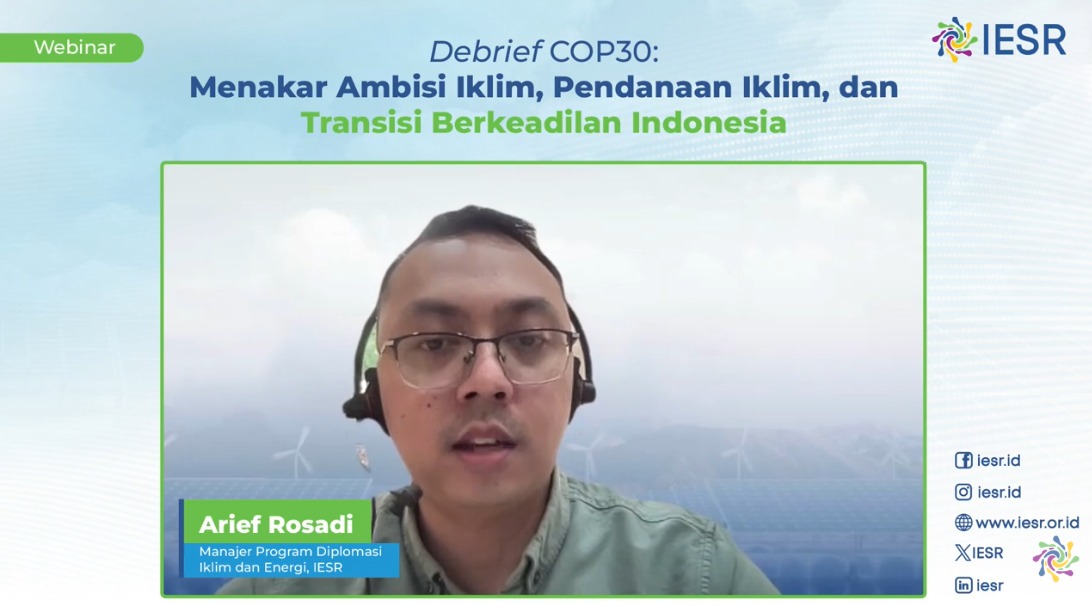
Arief Rosadi, IESR Climate and Energy Diplomacy Manager, stated that Indonesia has a strong political opportunity to take a leadership role among Global South countries in maintaining the spirit of climate action post-COP30. This aligns with President Prabowo Subianto’s statements at various international forums and the national target to achieve 100 percent renewable energy by 2035, as stated in the state speech at the People’s Consultative Assembly (MPR).
This commitment needs to be realized in three strategic steps. First, championing climate issues and energy transition in international forums as an anchor for green development. This role must be fulfilled by setting an example, namely ensuring that domestic policies truly reflect high climate ambition. Second, encouraging the translation of multilateral decisions into concrete partnerships.
“Indonesia has a track record as a leader in providing the foundation for global processes, both as the host of COP-13 which produced the Bali Roadmap, the G20 Chairmanship (2022) which gave birth to the Bali Compact and the Bali Energy Transition Roadmap, and during the ASEAN Chairmanship which resulted in the ASEAN Strategy for Carbon Neutrality,” added Arief.
Third, amplifying decisions and initiatives that support renewable energy. Indonesia needs to adopt and echo both formal decisions and non-formal initiatives from COP30 that practically encourage the acceleration of renewable energy and the gradual phase-out of fossil fuels. One idea that can be amplified is a “roadmap on transition away from fossil fuel,” to be promoted in other multilateral forums outside of the COP.