




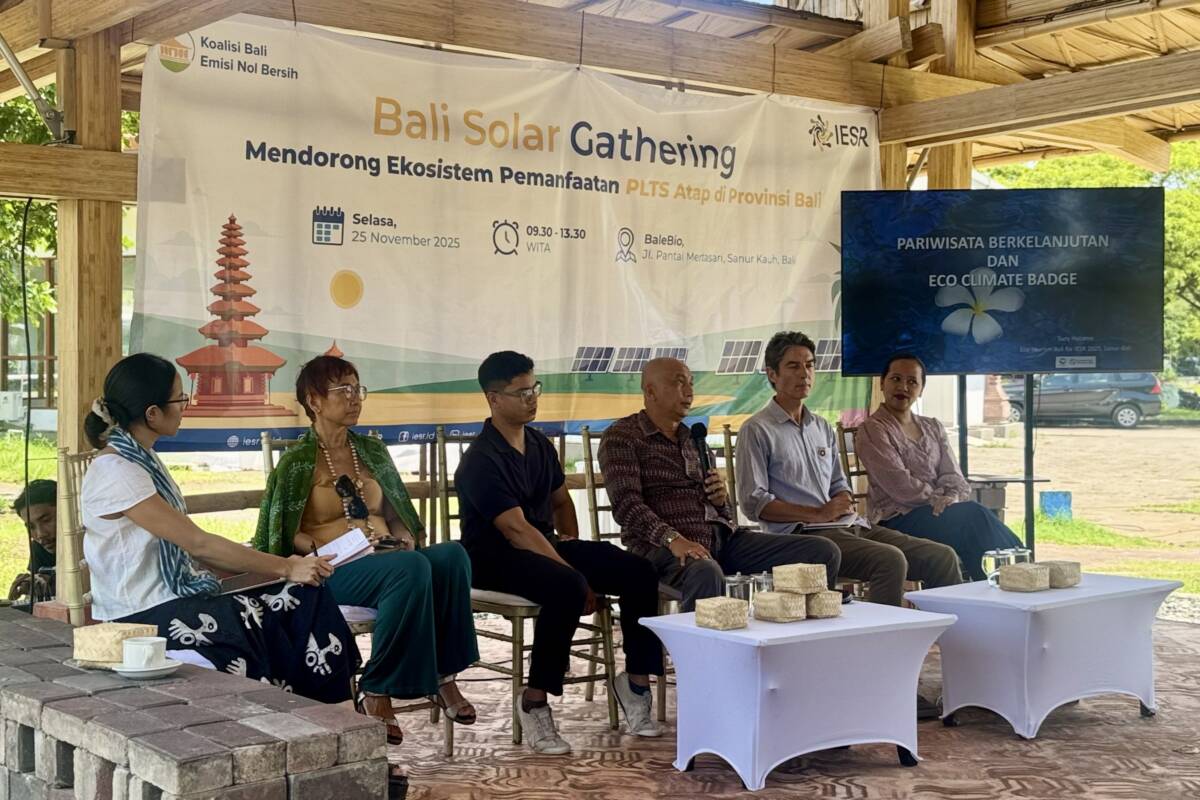
Denpasar, 25 November 2025 – The high level of activity in Bali’s tourism sector makes electricity a fundamental need, especially with the increasing number of accommodation facilities, shopping centers, attractions, and growing mobility. Looking at trends over the past two years, which show that the largest electricity consumption, around 50%, comes from the business sector (Statistics Indonesia, 2024), the Institute for Essential Services Reform (IESR) views the role and contribution of the business sector as crucial in building an energy system that is independent, clean, and sustainable. This role is not only important for achieving Bali Net Zero Emission 2045, but also for ensuring the resilience and sustainability of Bali’s economy.
As an initial step to enhance business sector engagement, IESR organised the Bali Solar Gathering, a forum that brings together rooftop solar users in the tourism industry to share experiences, challenges, solutions, policy updates, and policy recommendations that could support the growth of the rooftop solar ecosystem in Bali.
The presence of participants at the Bali Solar Gathering, consisting of 20 businesses and four government representatives, reflected the interest of business and tourism industry actors in advancing sustainability practices, including the adoption of rooftop solar. In addition to representatives from the Asosiasi Pengusaha Indonesia, most attendees were businesses already using rooftop solar systems.
Renewable energy-related policies already implemented in Bali were appreciated by participants because they are considered supportive of accelerating rooftop solar installations. However, the removal of the electricity export–import scheme was seen as regrettable, as it means surplus electricity produced by rooftop solar no longer has economic value. According to Heruanda Alviana Giska B. (Heru), Senior Building Energy Engineer at Eco-Mantra, this situation has reduced interest among some clients in adopting rooftop solar.
“Installing rooftop solar panels does not only consider the technical aspects, but there are also business considerations. Today, technologies such as modules, inverters, and batteries have become highly advanced and widely accessible. However, financial benefits for customers remain an important factor. Back then, there was a scheme that allowed PLN customers to export excess electricity from their rooftop solar systems back to the PLN grid, an opportunity that was highly attractive and profitable. Unfortunately, this scheme has now been discontinued, making it an additional consideration for customers who wish to install rooftop solar at home. We certainly hope that the export–import scheme can be reinstated in the future,” said Heru.
Despite these challenges, one of the key highlights from the discussion was the need for creativity in addressing existing barriers. For example, technical issues such as limited roof space can be overcome by renting rooftop areas from other buildings or integrating solar PV installations in alternative locations, such as parking areas–an approach applied at the parking area of the Bali Provincial Office of Manpower and Energy and Mineral Resources (Disnaker ESDM Provinsi Bali).
Given Bali’s strong artistic and cultural traditions, speaker Suzy Hutomo, Co-Founder of Eco Tourism Bali, also highlighted the opportunity to integrate aesthetic cultural elements into rooftop solar designs to better align with local identity.
“Cultural aspect is an important matter in Bali. If solar panels can be incorporated as part of Balinese architectural elements, they can blend seamlessly with traditional building designs. For example, solar panels could be decorated with Balinese carvings or designed with traditional patterns,” shared Suzy.
Further, Marc-Antoine Dunais, Founder and Director of Catalyze, emphasised the importance of honesty in communicating sustainability values. This means avoiding jargon and exaggerated claims that cannot be substantiated.
As mentioned by Marc, “Businesses need to show their efforts, for instance the goals they set, the progress they make, but also the setbacks. Honest communication builds more credibility, and we’re in a moment where trust in business has declined, especially in relation to sustainability and climate commitments”.
An authentic communication approach is seen as more effective in strengthening business competitiveness, particularly amid rising public skepticism toward sustainability practices and the prevalence of greenwashing.
Through the Bali Solar Gathering, it is hoped that more businesses and tourism industry players will be inspired to take an active role in adopting clean energy, particularly rooftop solar. With continued and expanded collaboration, Bali can accelerate its clean energy transition and move closer to achieving its vision of Bali Net Zero Emissions 2045.