




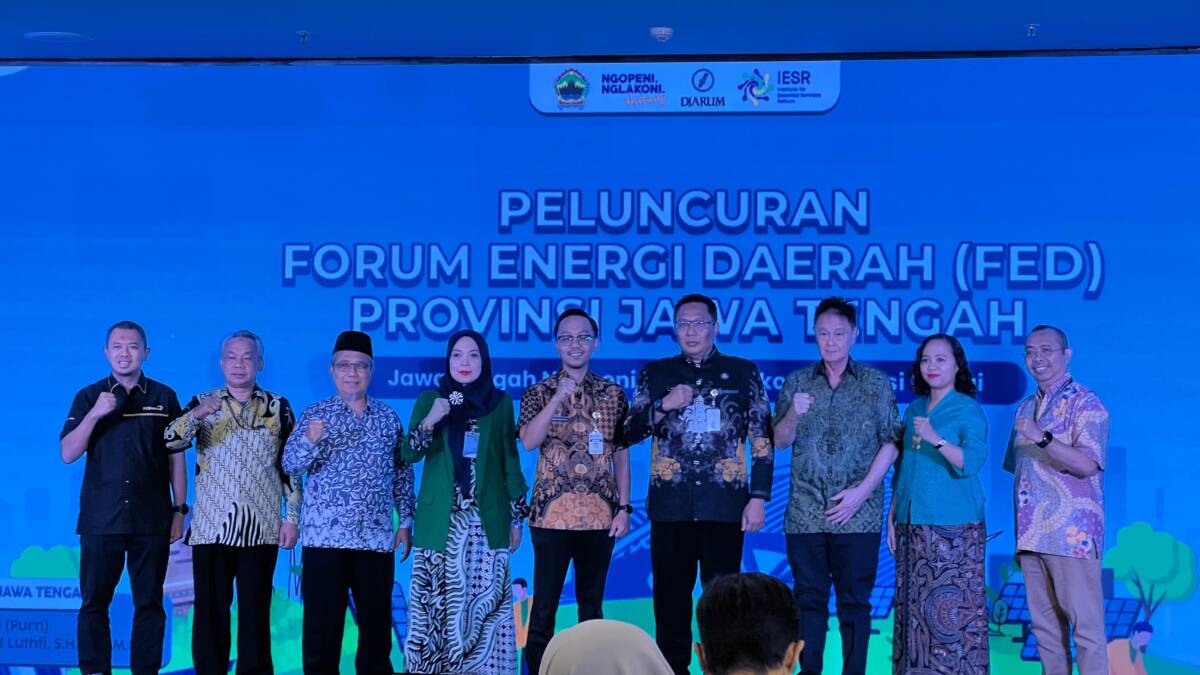
Kudus, 4 December 2025 — Central Java holds significant renewable energy potential, reaching approximately 197.96 GWp according to a study by the Institute for Essential Services Reform (IESR). However, the utilization of this potential remains suboptimal. In 2024, the province’s renewable energy mix reached only 18.58 percent, still below the 21.32 percent target set for 2025. This gap highlights the need for stronger efforts and strategic interventions to advance clean energy implementation at the regional level.
In response to this situation, the Provincial Government of Central Java emphasized the importance of cross-sector, multi-stakeholder collaboration through a more structured and sustainable coordination platform to accelerate the energy transition. To support this effort, the Central Java Provincial Government, through the Provincial Energy and Mineral Resources Office (DESDM), in collaboration with IESR and other strategic partners, officially established the Central Java Provincial Energy Forum, as mandated by Governor’s Decree Number 100.3.3.1/398 of 2025 on Thursday (16/10/2025).
Agus Sugiharto, Head of the Central Java Provincial Energy and Mineral Resources Office, stated that accelerating the energy transition is impossible without collaboration across all actors. Every stakeholder plays a complementary and essential role, including local government, the State Electricity Company (PLN), industry, academia, communities, and development partners. He explained that the Regional Energy Forum is expected to serve as a collaborative hub that drives tangible progress in the development of renewable energy in Central Java. Its structure has been designed comprehensively, consisting of a Steering Committee, a Daily Executive Body, and four working groups focused on regulation and data, financing, technology and infrastructure, as well as education and community empowerment.
Azhari Syauqi, Young Expert Planner at the Secretariat General of the National Energy Council, views the Regional Energy Forum as a crucial platform for strengthening supervision and improving progress toward regional clean energy targets. He outlined several strategic steps that regional governments can take, including updating the Regional Energy General Plan (RUED), implementing energy-saving regulations, expanding green open spaces, and enhancing capacity through partnerships with universities and central government institutions. According to him, the Forum plays a vital role in reinforcing oversight and supporting regional achievement of clean energy goals.
Meanwhile, Diah Perwitasari, Functional Planner at the National Development Planning Agency (Bappenas), emphasized that the Regional Energy Forum plays a strategic role in aligning national and regional planning, ensuring that programs are implemented in a more coordinated and synchronized manner. She stated that Bappenas supports the establishment of such forums across provinces, including fossil-producing regions, to provide structured spaces for dialogue, data-driven planning, and stronger cross-sector cooperation. She added that the Forum must be able to identify local energy potential, formulate measurable roadmaps, and integrate regional needs into national planning documents.
Marlistya Citraningrum, Sustainable Energy Access Program Manager at IESR, highlighted that the Forum represents a democratic space for collaboration in the energy transition, as access to energy has become a basic human need like clothing, food, shelter, and information. She noted that renewable energy, particularly solar PV, biogas, and swamp gas, offers communities the opportunity to become energy producers rather than relying solely on large-scale providers. Since 2019, Central Java has experienced significant progress, with local solar PV capacity increasing from under 2 MW to more than 50 MW. This expansion has been driven by global market requirements compelling export-oriented industries to use renewable energy, along with successful programs such as Energy-Independent Villages and solar PV installations for Islamic boarding schools and micro, small, and medium enterprises (MSMEs) supported by the regional budget.
Marlistya encouraged the Forum to strengthen multi-sector coordination and ensure that energy policies are translated into concrete programs down to the village level. She emphasized that consistent adoption of clean energy by government and public institutions provides an important example for communities and industries.
Furthermore, Suwarno, Deputy General Manager of Production Engineering at PT Djarum Oasis, presented the company’s sustainability practices through its “very green” concept, which had been implemented even before the regional energy transition initiatives. The company has undertaken energy, water, and environmental conservation efforts and has pursued decarbonization through solar PV development, switching boiler fuel from diesel to Compressed Natural Gas (CNG) and biomass, utilizing woodchips, and improving energy efficiency across production processes. He explained that the company’s decarbonization efforts are not merely about meeting standards but are part of its long-term business strategy, with clean energy, efficiency, and environmental restoration forming the foundation of operations that benefit both the company and the wider community.
“Decarbonization efforts are not merely meeting standards but are part of our long-term business strategy. Clean energy, efficiency, and environmental restoration form the foundation of our operations, delivering benefits both to the company and to the wider community,” he said.