




Jakarta, December 3, 2025 – The energy transition is inevitable. The falling prices of low-carbon technologies such as solar energy and batteries are one of the driving forces behind the shift to low-carbon technologies. Projections show that without any intervention, within the next 5-10 years, the price of solar power plants and batteries will be cheaper than building new coal-fired power plants.
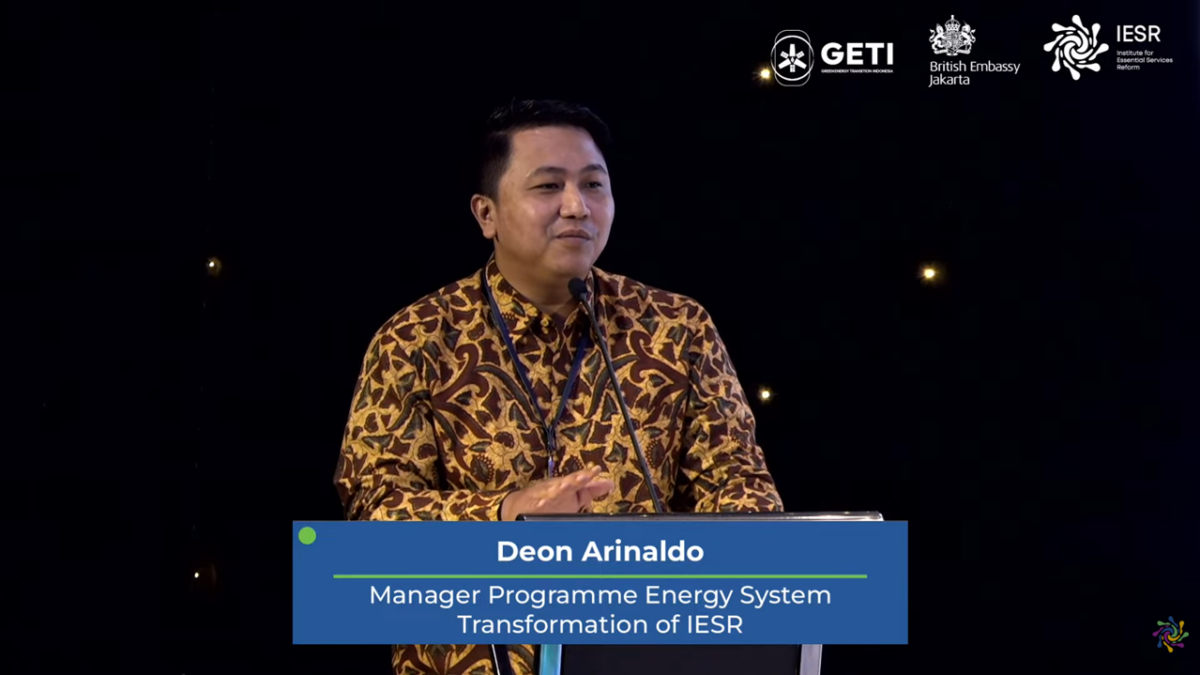
Deon Arinaldo, Energy System Transformation Program Manager at the Institute for Essential Services Reform (IESR), explained in his opening remarks at the Brown to Green Conference that it is crucial for Indonesia to start considering its economic diversification plan.
“Lesson learnt from other countries showed that it takes decades to transform the economy in coal-producing regions,” said Deon.
Deon added that there is a risk of infrastructure lock-in, a condition where too much fossil fuel infrastructure dominates, making energy transition efforts increasingly expensive due to the need to replace much of the infrastructure. If Indonesia does not immediately develop a transition and diversification plan, it will be difficult to achieve this. This will lower Indonesia’s economic competitiveness as multinational companies seek cleaner, lower-carbon energy sources.
Ianto Jones, Head of Low Carbon Energy and Infrastructure at the British Embassy in Jakarta, shared the UK’s experience in embarking its decarbonization journey, which began in 2012-2013 when coal dominated the UK’s energy system, reaching 40%, and carbon emissions causing economic and health losses of between $1.7 and $4.9 million per year.
“Starting in 2016, the UK implemented a carbon price of $25 per ton. This tariff made coal uneconomical and reduced its use in the energy system,” said Ianto.
Totoh Abdul Fatah, Director of Mineral and Coal Revenue, Ministry of Energy and Mineral Resources, stated that coal contributes significantly to Non-Tax State Revenue (PNBP). However, the amount of PNBP received fluctuates depending on global commodity prices.
“As mandated by Law No. 3/2020 concerning added value in mining, every mining company has a downstreaming plan, including downstreaming of methanol to ammonia, coal gasification, DME, and sink gas. The targets vary from 2025 to 2029, but we see that there are still various challenges, so we will be working towards achieving them,” said Totoh.
Robert, an Associate Expert Policy Analyst at the Ministry of Finance, stated that the Domestic Price Obligation (DPO) is a policy instrument to maintain the sustainability of the state budget.
“In terms of national energy policy, the government already has a roadmap to reduce the share of coal in the energy mix. However, the DPO tends to increase every year due to increasing energy demand and downstreaming. The government is also encouraging coal to be used not only as fuel but also for added value into other products such as methanol, ethanol, or ammonia fertilizer. The fiscal and energy impacts of this shift to a downstreaming model are currently being calculated,” he said.
Robert added that pricing, tax, and subsidy policies need to be designed to mitigate fiscal risks while still supporting the energy transition and maintaining national energy security.
Singgih Widagdo, Chairman of the Indonesian Mining and Energy Forum (IMEF), stated that the global coal market is fluctuating, and Indonesia, as a coal exporting country, needs to map out its coal utilization strategy.
“Going forward, as renewable energy and battery technology become more affordable, the risk of coal oversupply will increase. Coal prices are expected to struggle to rise significantly, while importing countries are starting to implement emissions trading policies, and ASEAN countries are nearing the peak of their coal mix,” Singgih stated.
Amidst these conditions, Indonesia, which has approximately 963 mines, must ensure that coal production declines are planned and scenario-based, rather than sudden declines without a transition. The goal is to maintain regional economic sustainability and prevent drastic declines in state revenues (especially non-tax state revenues).
Meliana Lumbantoruan, Deputy Director of Publish What You Pay (PWYP) Indonesia, stated that there is a socio-economic dependence of Indonesia’s coal-producing regions on the DMO/Domestic Price Obligation (DPO) policy. This economic dependence is accompanied by social vulnerabilities such as job losses. For every 100 million tons of coal production lost, 8,500-10,000 people lose their jobs. This vulnerability, which directly impacts communities, highlights the need for transition planning and funding.
“DMO and DPO reform is not about eliminating protection but rather restructuring the instruments so that it becomes a tool for a secure transition for (energy) supply, fair to the public, and stimulate clean investment. This requires a time-bound roadmap, market-responsive pricing, cross-ministerial socio-fiscal protection, and strengthened transparent governance,” she highlighted.