




Jakarta, 29 Januari 2026- A report by the World Economic Forum (WEF) shows that despite increasing efforts to improve energy efficiency and expand the use of renewable energy, particularly in developed countries, global carbon dioxide emissions rose in 2024, reaching approximately 38 gigatons. Emissions from hard-to-abate industrial sectors also increased on average. Among the eight major sectors such as steel, cement, chemicals, aluminum, oil and gas, aviation, shipping, and land transport, the aviation sector recorded the highest emissions growth, rising by 6.4% in 2024 compared to 2019.
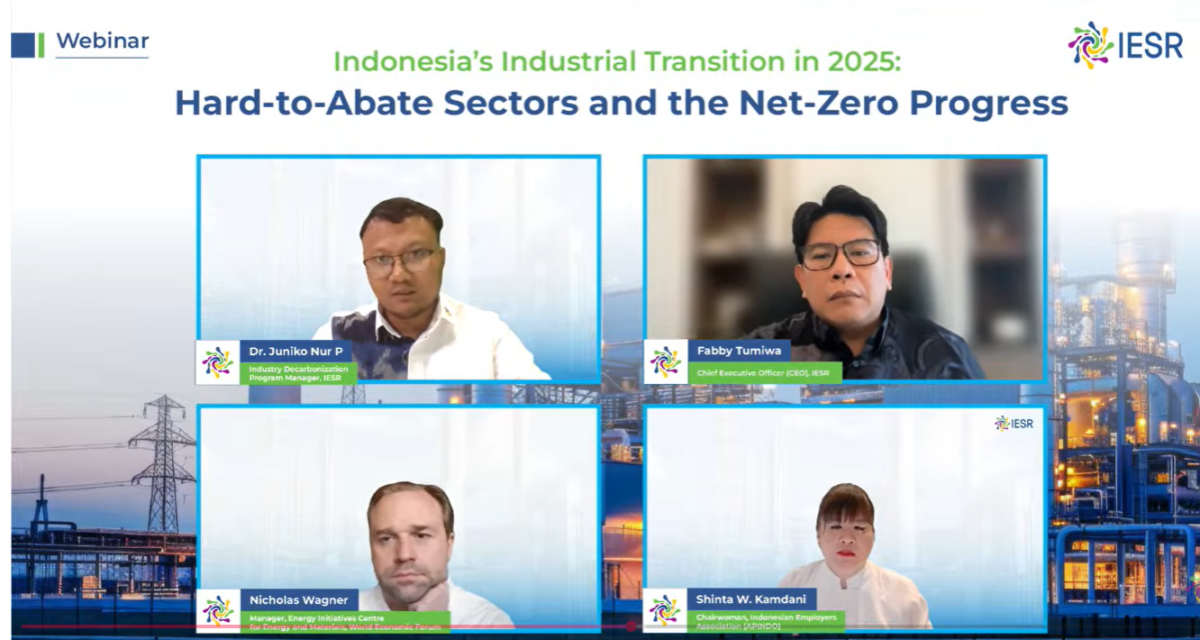
During the webinar Indonesia’s Industrial Transition in 2025: Hard-to-Abate Sectors and the Net-Zero Progress, organized by the Institute for Essential Services Reform (IESR) in collaboration with the World Economic Forum (WEF) on January 29, 2026, Fabby Tumiwa highlighted the growing gap in industrial decarbonization between developed and developing countries.
The most significant gaps lie in four areas which are financing, decarbonization pressures, access to and expertise in technology, and policy and governance. In terms of financing, developing countries require substantial climate finance, yet currently receive only about 40% of total global climate finance flows. At the same time, they are expected to decarbonize while still undergoing industrialization, whereas developed countries largely decarbonized after completing their industrialization phase.
Moreover, key emission-reduction technologies, such as green hydrogen, carbon capture and storage (CCUS), and electrification, remain largely concentrated in developed economies. These disparities are further compounded by weak policy frameworks and implementation challenges at the national level.
For Indonesia, Fabby recommends two policy measures that could be implemented within the next one to two years.
First, Indonesia should establish a mandatory green industrial procurement framework, supported by carbon-based incentives.
“The government can create a demand-pooling mechanism by requiring all public infrastructure projects, such as roads, bridges, and public buildings, to procure certified low-carbon steel and cement, which are among the most carbon-intensive materials,” explained Fabby
Second, Indonesia should operationalize a captive renewable energy framework for industrial clusters. Fabby encourages the implementation of a power wheeling policy specifically for renewable energy, enabling industrial clusters to meet their electricity needs from clean energy sources. In addition, the government could establish industrial green energy zones aligned with Indonesia’s downstreaming strategy, allowing industrial expansion and decarbonization to progress in parallel and reinforce one another.
Industrial Cluster Approach to Accelerate Decarbonization of Hard-to-Abate Sectors
Meanwhile, Nicholas Wagner, Manager of Energy Initiatives at the Centre for Energy and Materials, World Economic Forum, highlighted three important shifts in global industrial decarbonization. First, global climate policy is moving from voluntary commitments toward more binding accountability. Second, from a technological perspective, adoption decisions are increasingly shaped by the ability to deploy technologies at scale. Third, economic feasibility is becoming a central consideration in industrial decarbonization.
“There is a stronger emphasis on bankable projects. Importantly, in many emerging markets, affordable capital remains limited, creating a mismatch between where capital is needed and where it is most readily available. Exchange-rate volatility and high energy costs add further pressure, while trade policies and tariffs increasingly influence competitiveness and investment decisions.” said Wagner.
For the ASEAN region, Wagner considered the industrial cluster approach to hold significant potential. Clusters that connect heavy industry, ports, manufacturing, and airports enable risk sharing, shared infrastructure utilization, and demand aggregation. This approach is seen as particularly relevant for scaling hydrogen, CCUS, renewable energy, and digital systems, allowing decarbonization efforts to evolve from isolated pilot projects into financially viable investment platforms.
“Indonesia is a strong candidate for the development of next-generation industrial clusters,” he added.
Financing Becomes a Key Aspect of Decarbonization for Industry Players
From the business perspective, Shinta W. Kamdani, Chairwoman of the Indonesian Employers Association (APINDO), emphasized that hard-to-abate sectors continue to face challenges specific to local conditions. One example is Indonesia’s land transportation sector, where the implementation of policies such as axle-load restrictions or zero overloading has reduced truck carrying capacity and increased logistics costs.
Shinta acknowledged that financing remains the biggest challenge. Based on an APINDO survey of 2,000 companies in Indonesia, 66.8% of respondents identified financing as the primary obstacle. Decisions to pursue industrial decarbonization, she noted, are highly dependent on project bankability, the cost of capital, and execution risks.
“Without targeted de-risking investments to address financing constraints and microeconomic volatility, capital will continue to favor conventional projects,not due to a lack of commitment from industry, but because of fundamental bankability constraints,” Shinta explained.
She also highlighted the fragmentation of global climate policy, as well as the weak and fragmented demand for low-carbon products. According to her, this policy fragmentation risks turning industrial transition into a location-based cost burden, meaning that exporters from developing countries must bear compliance costs without equivalent support.
“Without stronger international alignment, competitiveness will be shaped more by policy location than by efficiency or genuine decarbonization progress,” Shinta concluded.