




Jakarta, November 20, 2025 – Indonesia finds itself in a paradoxical situation: it possesses abundant renewable energy potential, yet its energy system is dominated by fossil fuel power plants. For nine consecutive years, Indonesia has failed to achieve its renewable energy expansion target. Meanwhile, fossil fuel capacity continues to grow. This has left Indonesia in a state of infrastructure lock-in.
Fabby Tumiwa, Chief Executive Officer of the Institute for Essential Services Reform (IESR), in his opening remarks at the launch of the report “Indonesia Energy Transition Outlook (IETO) 2026: Rhetoric or Reality: Aligning Economic Growth with Energy Transition,” stated that Indonesia’s energy transition is stagnant.
“This doesn’t mean we can’t transition, but several factors are hindering the energy transition in Indonesia, including inconsistent policies, a fixation on coal because it’s considered cheap, limited electricity infrastructure, and funding misalignment,” Fabby said.
Fabby added that there are various economic opportunities if Indonesia decides to quickly move away from fossil fuel infrastructure. One example is the projected need for renewable energy for data centers, which is estimated to reach 6 GW.
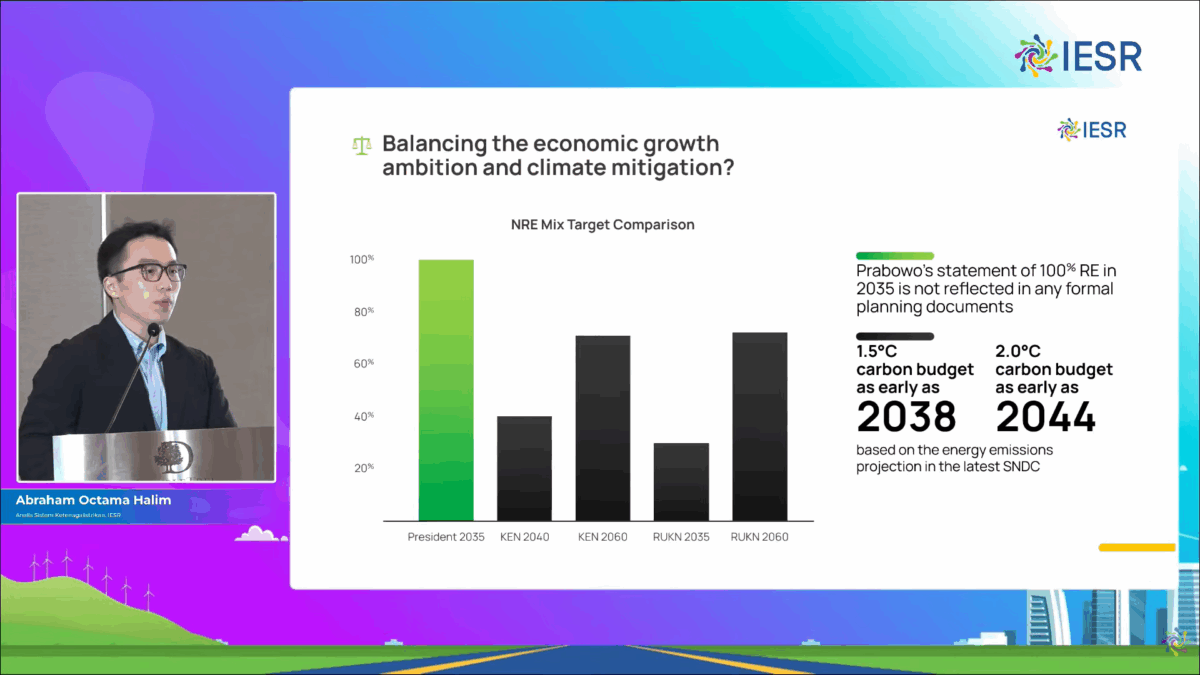
Abraham Octama Halim, an IESR Power Systems Analyst and lead author of IETO 2026, stated that if Indonesia follows current emission projections, the remaining carbon budget to keep global temperatures below 1.5°C will run out in 2038, and the 2°C limit will run out in 2044.
“Both 2038 and 2044 are still far from the 2060 NZE target, so we must increase the renewable energy mix to extend this carbon budget. Increasing renewable energy to 77% can ensure economic growth does not shift away from emission’s growth,” said Abraham.
Strengthening decarbonization efforts requires funding guarantees. Unfortunately, public funding allocations are still largely directed towards the extractive sector. Putra Maswan, IESR Financial and Economic Analyst, stated that international funding support such as JETP (Just Energy Transition Partnership) has not been optimal in supporting the energy transition agenda.
“Over the past year, there has been a positive trend among private banks in terms of investment allocation to the sustainability sector, but compared to investment allocations in the extractive sector, the figures are still small,” he said.
At the beginning of 2025, the four largest private banks’ investments in renewable energy development reached 36 trillion rupiah. Meanwhile, total investment in the extractive sector reached 267 trillion rupiah.
Putra also explained the results of the current renewable energy technology maturity assessment. Solar energy and battery technologies have entered a mature and commercially viable stage, while technologies such as ammonia gasification and CCS are still in the trial phase. Based on these assessment results, investment should be allocated to mature and proven technologies.
Shahnaz Nur Firdausi, Climate and Energy Analyst at IESR, added that the current challenges are not only technological but also encompass national development governance.
“In our modeling, greater penetration of renewable energy into the grid not only contributes to reducing GHG emissions but also contributes to economic growth. Our conclusion is that economic growth should not come at the expense of emission reduction efforts,” he said.
Shahnaz added that increasing renewable energy alone is not enough; the government needs integrated institutional and policy reforms. This means establishing a transparent roadmap for coal-fired power plant (PLTU) retirement that aligns with Presidential Regulation 112/2022.