




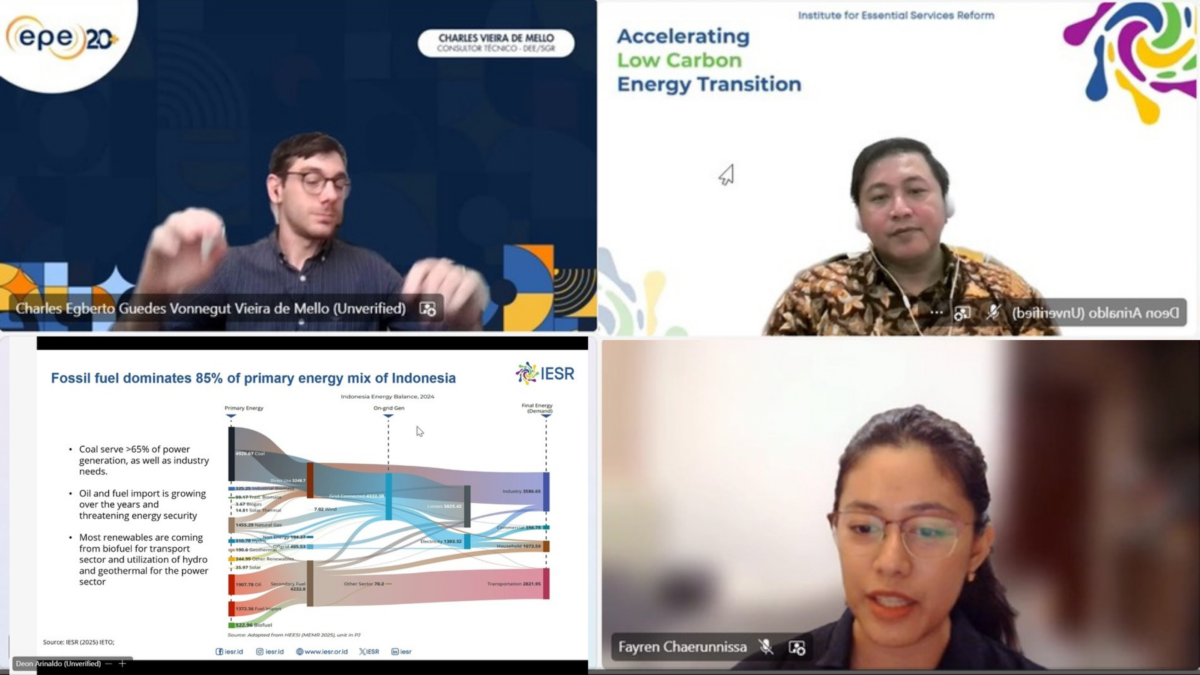
Jakarta, February 16, 2026 – Indonesia’s energy mix remains dominated by fossil fuels to this day. Approximately 85 percent of the national primary energy comes from fossil sources, with coal accounting for more than 65 percent of electricity generation and being widely used in the industrial sector. This was stated by Deon Arinaldo, Energy System Transformation Program Director at the Institute for Essential Services Reform (IESR), during a webinar titled “Exchange of Experiences in Transitioning to Renewable Energy in the Power Sector,” organized by the Brazilian Embassy in Jakarta on Thursday (12/6).
“This dependency not only results in high carbon emissions, but when international conflicts or tensions arise, energy supply and prices can be disrupted, ultimately impacting national economic stability. On the other hand, IESR studies show that the path toward a low-carbon energy system aligned with the 1.5°C temperature limit target is both technically and economically feasible,” Deon emphasized.
Deon stated that heading toward 2045, Indonesia has the potential to achieve a net-zero emission energy system based on 100 percent renewable energy. Approximately 1,500 GW of solar power capacity both utility-scale and distributed can be developed. Wind, hydro, and geothermal energy can also be utilized near their maximum potential. To maintain system reliability, energy storage capacity is projected to increase significantly to around 300 GW by 2050.
“Economically, this opportunity is also attractive. With current pricing mechanisms, there is approximately 333 GW of solar, wind, and mini-hydro potential that is financially viable, according to IESR studies. This potential is spread across various regions of Indonesia, with some located near PLN’s transmission networks and substations, making them relatively ready for development,” Deon explained.
Deon mentioned, utilizing renewable energy can enhance industrial competitiveness, attract clean energy investment, and create high-quality green jobs. With consistent policies and planned implementation, Indonesia has a massive opportunity to make the energy transition the foundation for more resilient and sustainable economic growth.