




Jakarta, November 28, 2025 – The Conference of Parties (COP30) held in Belem, Brazil, received mixed reactions, although many felt the COP30 results were disappointing. This did not reflect the current global urgency to immediately stem the increase in global warming and the role of the COP, which should strengthen global climate commitments.
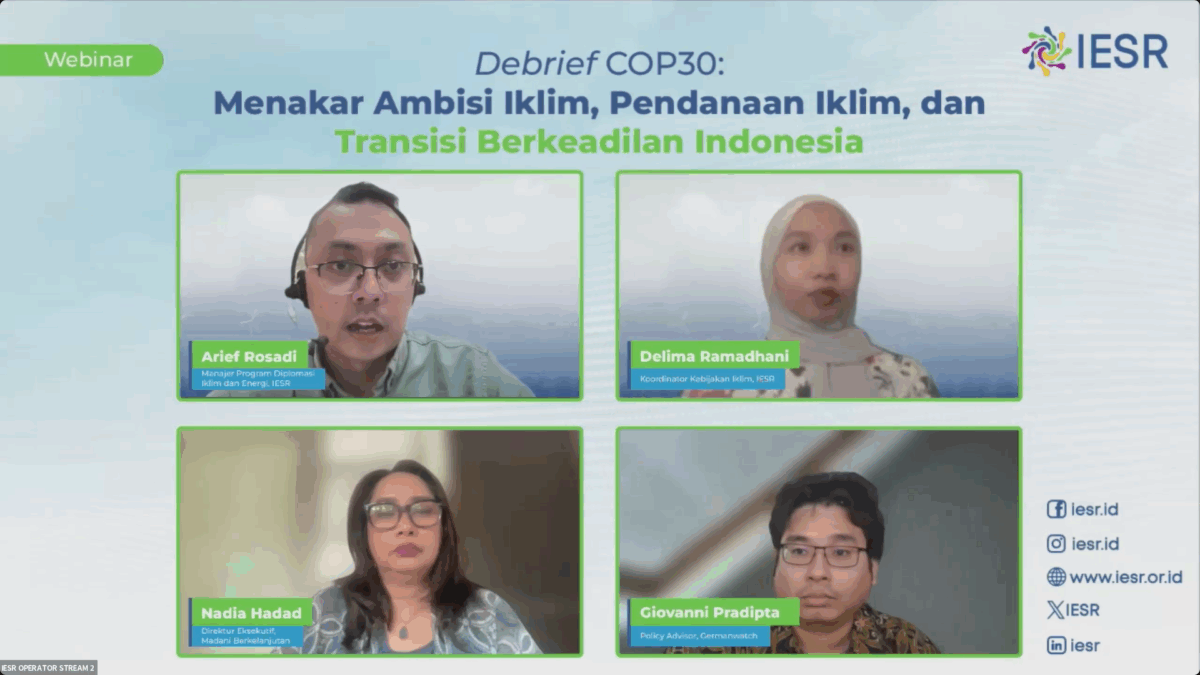
Arief Rosadi, Program Manager for Climate and Energy Diplomacy at the Institute for Essential Services Reform (IESR), during a webinar titled Webinar Debrief COP30: Menakar Ambisi Iklim, Pendanaan Iklim, and Transisi Berkeadilan Indonesia – YouTube stated that several important issues, such as the transition away from fossil fuels, were not included in the agreement document.
“The Global Mutirao Belem document is arguably not strong enough to encourage countries to strengthen their climate ambitions and move faster this decade,” Arief said.
IESR Climate Policy Coordinator, Delima Ramadhani, stated that this year is crucial given the adoption of the first Global Stocktake (GST). The Global Stocktake is a mechanism to assess the extent of climate action implementation, the magnitude of climate ambition, and the world’s position towards the 1.5°C target.
“The GST results show that the world must take action for rapid and sustained emissions reduction, and the world must reduce emissions by 43% by 2030,” he concluded.
Delima added that to achieve this target, the emissions reduction targets outlined in the Nationally Determined Contributions (NDC) are crucial and contextual. Unfortunately, based on the latest targets based on the NDC submitted to the UNFCCC, the world is still heading towards a warming of more than 2°C.
In the Indonesian context, Indonesia’s SNDC relies heavily on the forestry sector to absorb its emissions. Other efforts tend to be underdeveloped and will still produce emissions. Indonesia’s emissions reduction targets are supported by the forestry sector’s carbon sequestration. This is not strategically sound, because if forest emissions sequestration does not reach the target, Indonesia’s SNDC targets will not be achieved.
Furthermore, there is no clear commitment to phase out fossil fuels, and there are still references to “clean coal” and biomass co-firing in the policy mix. Even more worrying, Indonesia’s renewable energy targets are not aligned with the global need for renewable energy tripling.
Nadia Hadad, Executive Director of the Madani Berkelanjutan Foundation, highlighted the Tropical Forest Future Facility (TFFF) initiative, which will provide funding to countries that successfully curb tropical deforestation.
“Indonesia has the opportunity to receive this funding. As a prerequisite, Indonesia must develop detailed planning so that it has a credible NDC investment and implementation plan document with data-based estimates of FOLU, energy, and adaptation costs,” said Nadia.
Giovani Pradipta, Policy Advisor at Germanwatch, explained that the UNFCCC launched the Just Transition Work Programme (JTWP) initiative to help countries prepare transition plans.
“A just transition is a comprehensive, multi-sectoral effort. Several countries have begun sending officials equivalent to ministers of socio-economic affairs to the COP negotiations. This shows that countries are beginning to understand that transition is not only about the environment and climate but also socio-economic issues,” he said.