
Low-Carbon Transition: Economic Opportunity or Burden?

Jakarta, February 20, 2026 – Energy transition is often perceived as an expensive agenda that burdens the economy. However, according to Reananda Hidayat, Sustainable Mobility, Clean Environment, and Buildings Staff at IESR, this assumption is no longer relevant given recent developments. According to him, renewable energy technology has actually become the most economical choice today.…
Read More

Report and Policy Brief Launching on The Indonesia Captive Power Decarbonization  

Background The growth of Indonesia's manufacturing industry in recent years has been matched by a rapid increase in the use of captive power plants, which remain dominated by fossil-fuel-based energy sources. Dependence on these carbon-intensive plants poses a long-term risk of carbon lock-in, potentially hindering the achievement of Indonesia's Net Zero Emission targets and increasing…

Read More

ASEAN’s Opportunity to Lead Energy Transition Following US Withdrawal from the Global Climate Agenda

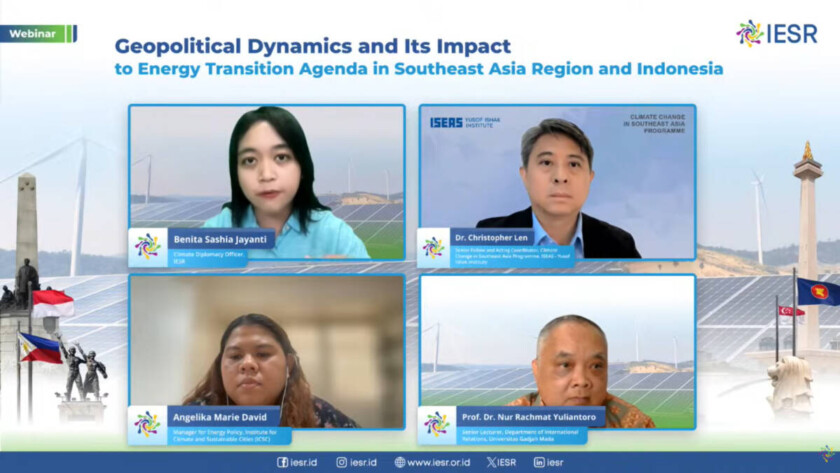
Jakarta, February 12, 2026 – In January 2026, the United States (US) announced its intention to withdraw from climate negotiations under the United Nations Framework Convention on Climate Change (UNFCCC) and from the Intergovernmental Panel on Climate Change (IPCC). This move follows the US withdrawal from the Paris Agreement in January 2025.  This decision has…

Read More

Report Launching on Solar Archipelago: Delivering 100 GW Solar PV Program in Indonesia In Collaboration IESR and the Coordinating Ministry for Economic Affairs (CMEA)

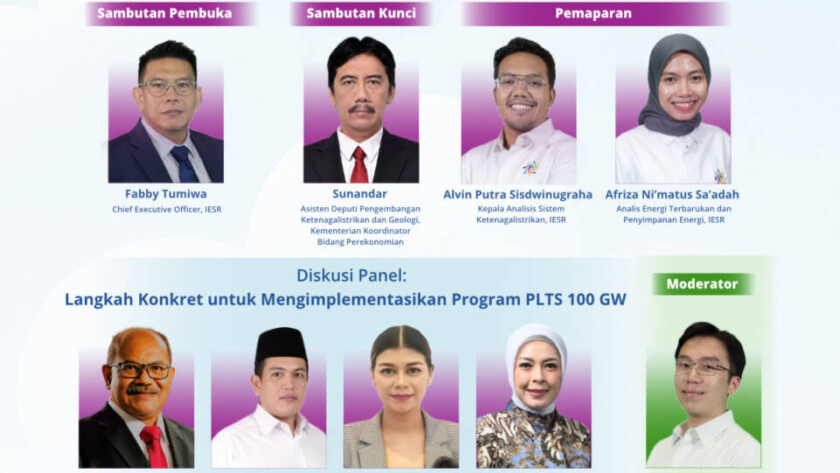
Background The Ministry of Energy and Mineral Resources (KESDM) has published the National Electricity General Plan (RUKN) for the 2025-2060 period. The RUKN document states that to achieve the NZE by 2060 or earlier, an average annual increase in power generation of approximately 9.6 GW is required to reach a total capacity of 443 GW…

Read More

IESR’s Response to 2025 Energy Performance Achievements: Stagnant Energy Transition, Threatened Energy Security

This statement is attributed to Fabby Tumiwa, Chief Executive Officer of the Institute for Essential Services Reform (IESR). In general, the performance of the Ministry of Energy and Mineral Resources (MEMR) shows disappointing results according to the following data: 1. Oil Lifting The Ministry of MEMR reported an average oil lifting (including Natural Gas Liquid/NGL)…

Read More

Strengthening Collaboration to Accelerate Renewable Energy Development in Central Java

Kudus, 4 December 2025 — Central Java holds significant renewable energy potential, reaching approximately 197.96 GWp according to a study by the Institute for Essential Services Reform (IESR). However, the utilization of this potential remains suboptimal. In 2024, the province’s renewable energy mix reached only 18.58 percent, still below the 21.32 percent target set for…

Read More

IESR: Indonesia Needs to Strengthen Climate Action Post-COP30

Jakarta, 8 December 2025 - The 30th UN Climate Change Conference (Conference of Parties, COP30) in Belém, Brazil, officially concluded on Saturday (22/11). The meeting resulted in the Global Mutirão or Global Gotong Royong document, which contains new initiatives, including the Global Implementation Accelerator (GIA) to speed up the implementation of climate mitigation and…

Read More

The Dynamics of the Indonesian Coal Industry Transitioning Towards a Greener Energy System

Jakarta, December 3, 2025 – The energy transition is inevitable. The falling prices of low-carbon technologies such as solar energy and batteries are one of the driving forces behind the shift to low-carbon technologies. Projections show that without any intervention, within the next 5-10 years, the price of solar power plants and batteries will…

Read More

Reducing the Dominance of Captive Coal-Fired Power Plants to Strengthen Long-Term Competitiveness

Jakarta, December 5, 2025 - The Institute for Essential Services Reform (IESR) notes that the world is rapidly shifting toward a low-emission economic system. In 2025, global investment in renewable energy, electricity grids, and batteries reached USD 2.2 trillion, double the amount invested in fossil fuels. Beginning January 2026, the European Union will also enforce…

Read More