



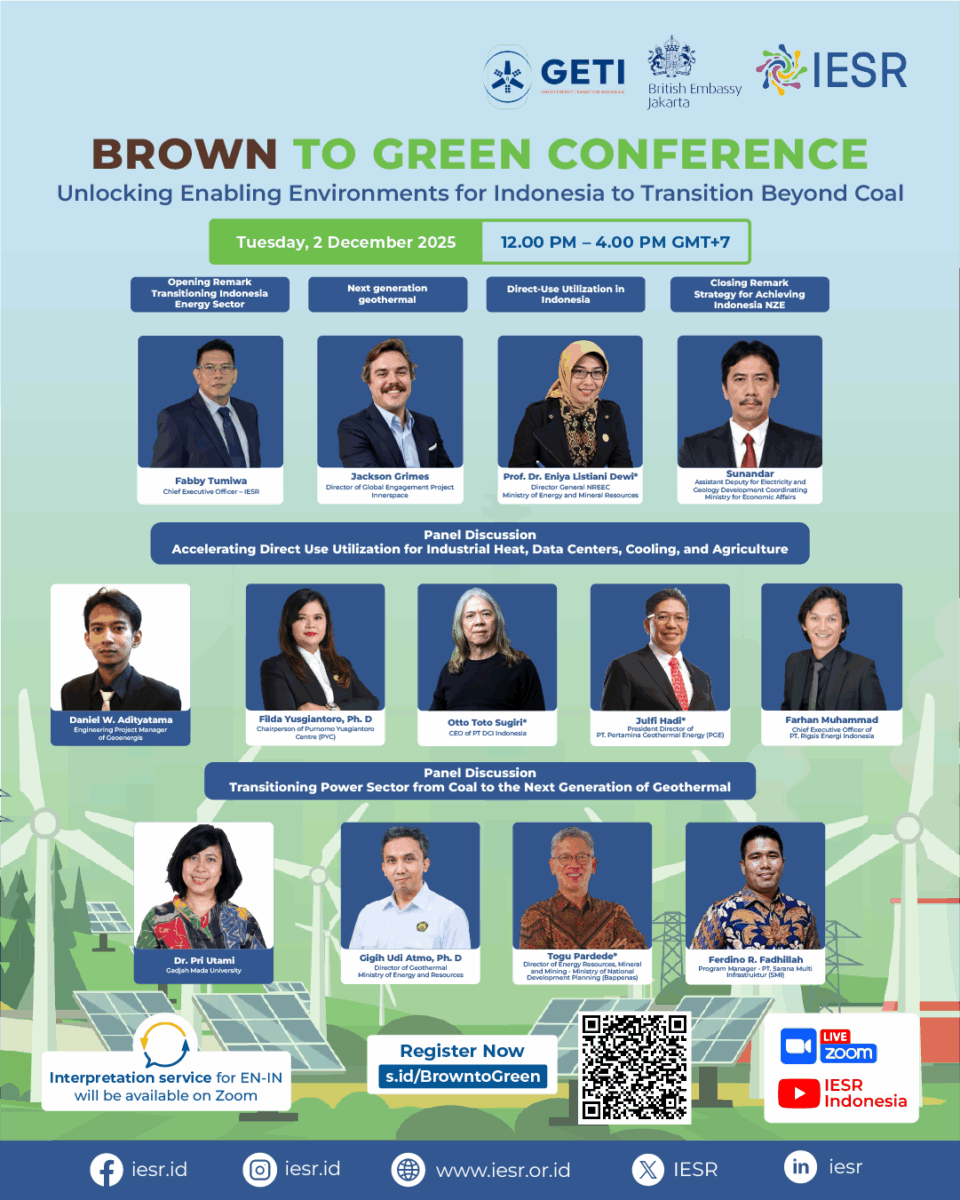
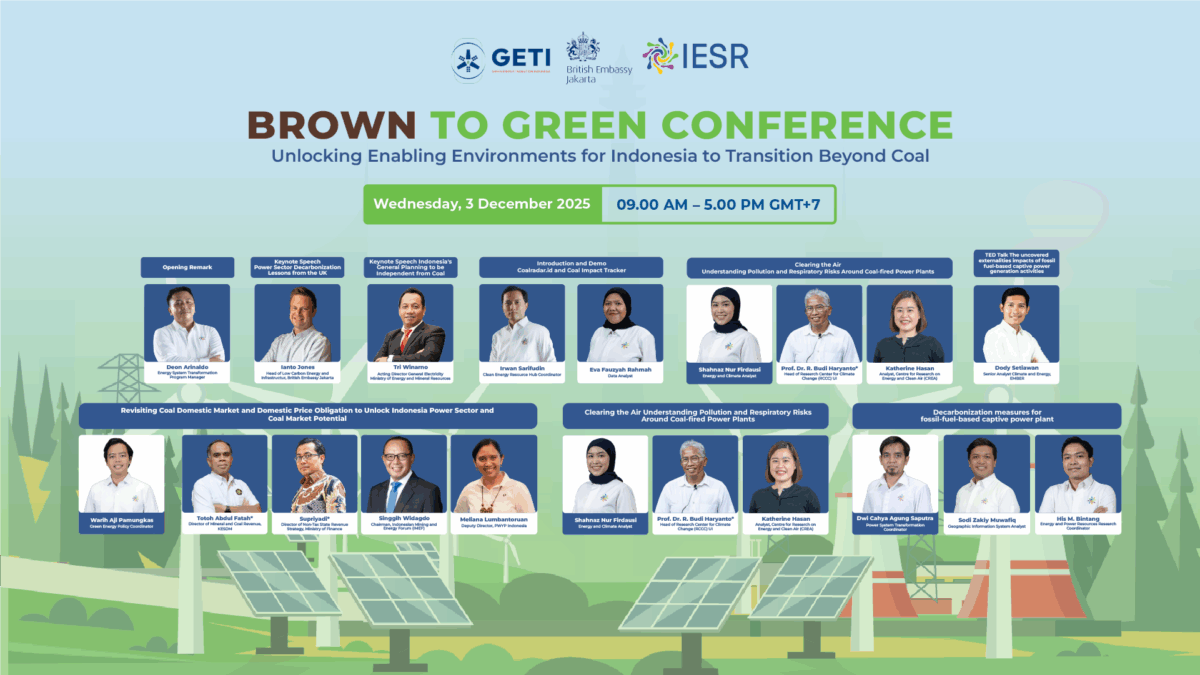
Brown to Green Conference: Unlocking Enabling Environments for Indonesia to Transition Beyond Coal
Replay Event
DAY 1
DAY 2
Background
Indonesia is currently at a critical juncture in its energy transition journey toward a cleaner, more sustainable, and equitable energy system. The country’s heavy reliance on coal as its primary energy source has resulted in significant environmental and social impacts, posing major challenges to achieving its net-zero emissions target. President Prabowo Subianto’s public commitment to support the energy transition sends a strong signal to all stakeholders to accelerate efforts toward decarbonizing the energy sector.
In recent years, there has been a growing trend in the development of fossil-fuel-based captive power plants, primarily to meet industrial energy demands. These plants operate outside the national electricity grid and have distinct operational characteristics, adding complexity to decarbonization efforts. A strategic, holistic, and cross-sectoral approach is therefore essential to drive an inclusive and just transformation of Indonesia’s energy system.
According to the performance report for the second semester of 2025 from the Ministry of Energy and Mineral Resources (MEMR), Indonesia’s national power system recorded an additional installed capacity of 4.4 GW. Of this total, only 876.5 MW came from renewable energy power plants, while the remaining 3.5 GW originated from fossil fuel-based power plants. Meanwhile, IESR’s findings indicate that by the end of 2024, there was an additional 4.3 GW of captive power generation capacity, dominated by fossil fuel plants (approximately 90%) and only around 10% from renewable sources. The significant increase in fossil-fuel-based power generation capacity, both within the on-grid and captive systems, poses a serious threat to Indonesia’s ability to meet its emission reduction targets, as committed in both the Second NDC and the JETP framework.
Recognizing the urgency for strategic action by the government and relevant stakeholders to reduce Indonesia’s dependence on fossil fuels, particularly coal, IESR—as a think tank focused on energy and environmental issues—has conducted a series of data-driven studies aimed at decarbonizing activities in the coal-dominated power sector. Under the theme “Unlocking Enabling Environments for Indonesia to Transition Beyond Coal,” IESR is organizing the Brown to Green Conference to disseminate various studies related to efforts to decarbonize coal-dependent power sector activities, including research on geothermal energy as a potential replacement for coal-fired power plants (CFPPs).
Indonesia is currently at a critical juncture in its energy transition journey toward a cleaner, more sustainable, and equitable energy system. The country’s heavy reliance on coal as its primary energy source has resulted in significant environmental and social impacts, posing major challenges to achieving its net-zero emissions target. President Prabowo Subianto’s public commitment to support the energy transition sends a strong signal to all stakeholders to accelerate efforts toward decarbonizing the energy sector.
In recent years, there has been a growing trend in the development of fossil-fuel-based captive power plants, primarily to meet industrial energy demands. These plants operate outside the national electricity grid and have distinct operational characteristics, adding complexity to decarbonization efforts. A strategic, holistic, and cross-sectoral approach is therefore essential to drive an inclusive and just transformation of Indonesia’s energy system.
According to the performance report for the second semester of 2025 from the Ministry of Energy and Mineral Resources (MEMR), Indonesia’s national power system recorded an additional installed capacity of 4.4 GW. Of this total, only 876.5 MW came from renewable energy power plants, while the remaining 3.5 GW originated from fossil fuel-based power plants. Meanwhile, IESR’s findings indicate that by the end of 2024, there was an additional 4.3 GW of captive power generation capacity, dominated by fossil fuel plants (approximately 90%) and only around 10% from renewable sources. The significant increase in fossil-fuel-based power generation capacity, both within the on-grid and captive systems, poses a serious threat to Indonesia’s ability to meet its emission reduction targets, as committed in both the Second NDC and the JETP framework.
Recognizing the urgency for strategic action by the government and relevant stakeholders to reduce Indonesia’s dependence on fossil fuels, particularly coal, IESR—as a think tank focused on energy and environmental issues—has conducted a series of data-driven studies aimed at decarbonizing activities in the coal-dominated power sector. Under the theme “Unlocking Enabling Environments for Indonesia to Transition Beyond Coal,” IESR is organizing the Brown to Green Conference to disseminate various studies related to efforts to decarbonize coal-dependent power sector activities, including research on geothermal energy as a potential replacement for coal-fired power plants (CFPPs).
Objectives
- Disseminating IESR’s research findings on efforts to decarbonize coal-dependent activities in the power sector, as well as studies on geothermal energy.
- Discussing the most realistic policy recommendations that can be implemented by the government and relevant stakeholders based on IESR’s research results.
Presentation
The Future of Geothermal in Indonesia _ Jackson Grimes _ Project Innerspace
The-Future-of-Geothermal-in-Indonesia-_-Jackson-Grimes-_-Project-InnerspacePresentasi Coal Radar & Coal Impact Tracker _ Irwan Sarifudin & Eva Fauzyah _ IESR
Presentasi-Coal-Radar-Coal-Impact-Tracker-_-Irwan-Sarifudin-Eva-Fauziah-_-IESRKewajiban dan Harga Domestik Batubara _ Totoh Abdul Fatah _ Kementrian ESDM
Kewajiban-dan-Harga-Domestik-Batubara-_-Totoh-Abdul-Fatah-_-Kementrian-ESDMArah Pasar Batubara Global _ Singgih Widagdo _ Indonesian Mining & Energy Forum (IMEF)
Arah-Pasar-Batubara-Global-_-Singgih-Widagdo-_-Indonesian-Mining-Energy-Forum-IMEFReformasi DMO-DPO _ Meliana Lumbantoruan _ PWYP
Reformasi-DMO-DPO-_-Meliana-Lumbantoruan-_-PWYPPower System Flexibility as Key for Maintaining Power System Reliability _ Abrahan O _ IESR
Power-System-Flexibility-as-Key-for-Maintaining-Power-System-Reliability-_-Abrahan-O-_-IESRFlexible CFPPs to Accommodate Rapid Penetration of Variable Renewable Energy _ Raditya Wiranegara _ IESR
Flexible-CFPPs-to-Accommodate-Rapid-Penetration-of-Variable-Renewable-Energy-_-Raditya-Wiranegara-_-IESRThe Uncovered Externalities Impacts of Fossil Fuel-based Captive Power Generation _ Dody Setiawan _ Ember
The-uncovered-externalities-impacts-of-fossil-fuel-based-captive-power-generation-_-Dodi-Setiawan-_-EmberIntroducing to Fossil Fuel Captive Power Plant Mapping _ Sody Zakiy _ IESR
Introducing-to-Fossil-Fuel-Captive-Power-Plant-Mapping-_-Sody-Zakiy-_-IESRLessons Learned and Key Recommendations to Decarbonize Captive Power Plant in Industry _ His Muhammad _ IESR
Lessons-Learned-and-Key-Recommendations-to-Decarbonize-Captive-Power-Plant-in-Industry-_-His-Muhammad-_-IESR